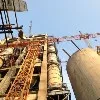
Tower crane is one of the most commonly used lifting equipment on construction sites, also known as "tower crane", with a section length (height) (referred to as "standard section"), used to hang construction steel bars and corrugations, Concrete, steel pipes and other construction materials. Tower crane is an indispensable equipment on the construction site.
The function of the tower crane tip is to withstand the upper loads from the boom pull rope and the balance arm pull rope, and transfer it directly to the tower body structure through the turntable through the structural components such as the rotating tower, turntable, and bearing. The top of the self-elevating tower is of truncated cone type, forward or backward tilted truncated cone type, herringbone type and diagonal brace type. All upper slewing tower cranes need to be equipped with a counterweight, whose function is to support the counterweight, which is used to form a balancing moment in the opposite direction of the lifting moment required by the design. In addition to the balance weight, a hoisting mechanism is often installed at the tail. The reason why the lifting mechanism is placed with the balance weight at the end of the balance arm, one can play the role of partial distribution weight, and the other is to increase the distance between the rope drum and the spire of the spire, so as to facilitate the winding of the wire rope and avoid the occurrence of Rope phenomenon. The amount of balance weight is inversely proportional to the length of the balance arm, and there is a certain proportional relationship between the length of the balance arm and the length of the boom. The balanced weight is considerable. Light tower cranes generally require at least 3 to 4 tons, and heavy-duty cranes require nearly 30 tons.