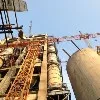
A tower crane whose boom is mounted on a rotating crane above the tower. Large working space, mainly used for vertical and horizontal transportation of materials and installation of building components in house construction.
Tower cranes are simply referred to as tower cranes, also known as tower cranes, and originated in Western Europe. From the perspective of tower crane technology development, although new products emerge in an endless stream, new products have improved in production efficiency, easy operation, easy maintenance and reliable operation, but the tower crane technology has not changed fundamentally. The research of tower crane is moving towards the combined development. The combined type is to take the tower body structure as the core, decompose the tower body into several parts according to the structural and functional characteristics, and divide the parts into several modules according to the principle of serialization and generalization, following the principle of the modular system. According to the parameter requirements, select appropriate modules to form tower cranes with different technical performance characteristics to meet the specific needs of construction. The implementation of combined tower cranes will help speed up the development of tower crane products, save product development costs, and better serve customers.
Tower cranes are divided into two categories: upper slewing tower cranes and lower slewing tower cranes. The bearing capacity of the former is higher than that of the latter. What we have seen in many construction sites is the tower crane with the upper rotary type, the upper lifting and the joint height. According to whether it can move, it is divided into walking type and fixed type. The tower body of the fixed tower crane is fixed and does not turn, and is installed on the whole concrete foundation, or on the X-shaped concrete foundation in the form of a bar. The fixed type is generally adopted in the construction of houses.
There are two types of booms for tower cranes: horizontal type and pressure bar type. When the boom is horizontal, the truck moves along the horizontal boom and the amplitude of the movement is balanced. The boom is longer, but the weight of the boom is larger. When the boom is a pressure bar type, the luffing mechanism pulls the boom up and down, and the luffing motion is not as smooth as the horizontal type, but its own weight is small. The lifting capacity of the tower crane varies with the amplitude.
To ensure safety, tower cranes have good safety devices.
The tower crane has a large ratio of height to the bottom support size, and the tower has a high center of gravity, high torque, frequent starting and braking, and large impact force. In order to increase its stability, we must analyze the main reasons for the tower crane's tipping: 1. Overload. 2. Oblique hanging. 3. The foundation of the tower crane is not flat, the ground endurance is not enough, and the excessive verticality error will also cause the tower crane's overturning moment to increase and reduce the stability of the tower crane.
Therefore, we must proceed from these critical factors to strictly check and check the gate to prevent major equipment personal safety accidents.